
Imagine telling your parents you don’t want to become a doctor, engineer, or Chartered Accountant (CA), but instead want to study Artificial Intelligence, Behavioral Psychology, or Renewable Energy. A decade ago, that might have sounded unrealistic. Today, however, these emerging fields are producing graduates who are getting hired faster than many traditional professions.
The degrees that mattered in 2010 are not necessarily the ones that will dominate in 2026. Industries are evolving, hiring patterns are shifting, and new career paths are emerging. The most in-demand degrees today are shaped by technological advancement, global challenges, and market needs. In this guide, we explore the top degrees for the future, supported by real-world examples, salary insights, and industry trends.
Understanding Future-Ready Degrees in 2026
Choosing the right degree today can feel like predicting the future in a rapidly changing world. Artificial Intelligence is transforming industries, climate technology is accelerating, and digital transformation is reshaping job roles.
Consider Sundar Pichai, who studied Metallurgical Engineering—far from the typical path to tech leadership. His curiosity, adaptability, and strategic thinking led him to the top position at Google. His journey highlights that success comes from combining foundational knowledge with evolving skills.
Understanding future-proof degrees equips students with relevant expertise, increases employability, and supports long-term career growth in a competitive global market.
What Makes a Degree “Future-Proof”?
A future-proof degree goes beyond securing your first job—it builds a sustainable career that withstands global shifts and digital disruption.
Degrees become future-proof when they align with major trends such as:
-
AI adoption
-
Renewable energy expansion
-
Healthcare innovation
-
Data-driven decision-making
Science, Technology, Engineering, and Mathematics (STEM) fields and healthcare are projected to grow significantly by 2030. Employers increasingly seek graduates who combine technical proficiency with human-centered skills like analytical thinking, adaptability, and emotional intelligence.
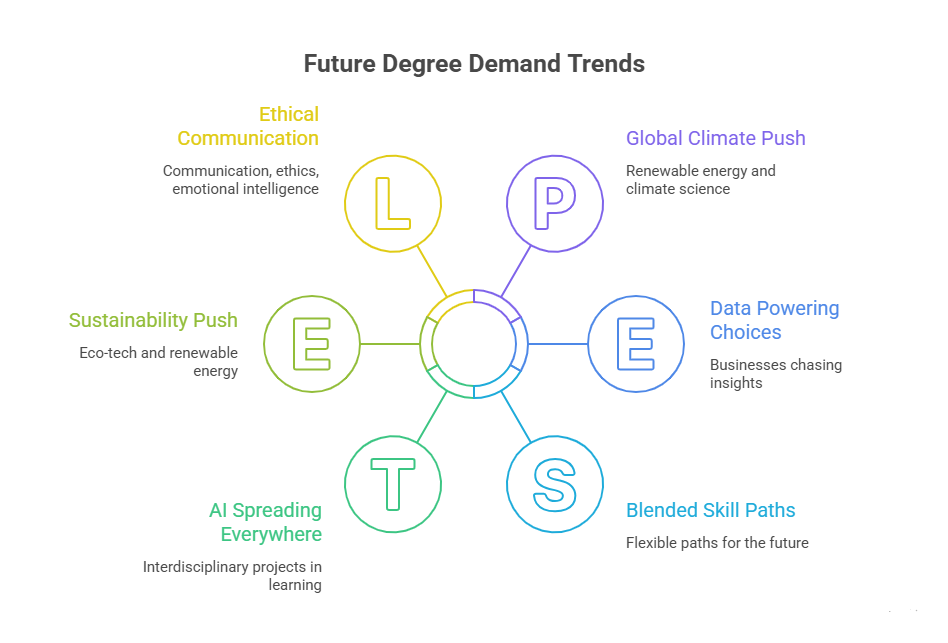
Five Key Trends Driving Degree Demand
1. AI Integration Across Industries
Artificial Intelligence is no longer limited to software development. It is transforming education, art, healthcare, business, and more. Interdisciplinary skills—blending creativity with data—are becoming highly valuable.
2. Data-Driven Decision Making
Every industry now relies on data. Skills in Python, SQL, analytics tools, and visualization are essential for turning raw information into actionable insights.
3. Sustainability and Climate Innovation
Global efforts to address climate change are creating demand for renewable energy specialists, sustainability consultants, and environmental engineers.
4. Hybrid Skill Combinations
Students are combining disciplines—such as business with computer science—to create flexible, competitive career paths.
5. Rising Importance of Soft Skills
Communication, ethics, adaptability, and emotional intelligence are critical in the digital economy. Employers value professionals who can collaborate and lead—not just execute technical tasks.
Top 15 Degrees in Demand for the Future
Many high-growth careers are concentrated in technology, healthcare, and sustainability. Below is a refined overview of leading degrees, career paths, and why they matter.
1. Computer Science & Artificial Intelligence
According to the U.S. Bureau of Labor Statistics, computer and IT roles are projected to grow steadily due to increasing automation and digital transformation.
Careers:
Software Developer, AI/ML Engineer, Robotics Engineer, Cloud Engineer, DevOps Specialist
Median Salary (US): ~$120,000/year
Why it’s future-proof: Automation still requires human oversight, optimization, and innovation.
2. Data Science & Analytics
Data powers modern business decisions. Organizations need professionals who can identify trends and forecast outcomes.
Careers:
Data Scientist, Machine Learning Engineer, Business Intelligence Analyst
Median Salary (US): ~$103,000/year
Why it’s future-proof: Every industry depends on predictive analytics.
3. Nursing & Advanced Practice Nursing
With aging populations and expanding healthcare systems, Nurse Practitioners play a crucial role in patient care.
Careers:
Registered Nurse, Nurse Practitioner, Telehealth Specialist
Median Salary (US): ~$94,000–$113,000/year
Why it’s future-proof: Healthcare demand continues to rise globally.
4. Cybersecurity & Information Security
Cyber threats are increasing rapidly, making digital protection essential.
Careers:
Cybersecurity Analyst, Ethical Hacker, Cloud Security Specialist
Median Salary (US): ~$102,000/year
Why it’s future-proof: Digital systems require constant protection.
5. Physician Assistant
Physician Assistants help bridge gaps in healthcare systems.
Median Salary (US): ~$113,000/year
Why it’s future-proof: Physician shortages increase reliance on PAs.
6. Healthcare Administration
Healthcare systems need skilled leaders to manage operations and improve efficiency.
Median Salary (US): ~$86,000/year
7. Biomedical Engineering
Designing medical devices and life-saving technology.
Median Salary (US): ~$81,000/year
8. Financial Technology (FinTech)
FinTech blends finance and technology, transforming global payments and investments.
Careers:
Blockchain Developer, FinTech Architect
Median Salary (US): ~$114,000/year
Why it’s future-proof: Finance is increasingly digital.
9. Renewable Energy Engineering
Countries investing in sustainability require renewable energy experts.
Median Salary (US): ~$90,000/year
Why it’s future-proof: Climate policies drive long-term demand.
10. Physical Therapy (DPT)
Rehabilitation professionals support recovery and mobility.
Median Salary (US): ~$79,000/year
11. Systems & Business Analytics
Bridging business strategy with technical analytics.
Median Salary (US): ~$82,000/year
12. Information Technology Management
Overseeing digital infrastructure and IT operations.
Median Salary (US): ~$98,000/year
13. Occupational Therapy
Supporting patients in regaining life skills.
Median Salary (US): ~$96,000/year
14. Supply Chain & Logistics
Managing global trade and e-commerce operations.
Median Salary (US): ~$81,000/year
15. Mental Health Counseling
Providing psychological support as mental health awareness rises.
Median Salary (US): ~$53,000/year
Why it’s future-proof: Mental health services are expanding across sectors.
How to Choose a Future-Proof Degree: 5-Step Framework
Step 1: Identify Core Interests and Strengths
Focus on mastering one strong skill deeply rather than collecting multiple shallow skills.
Step 2: Research Market Demand
Review industry trends, hiring data, and growth forecasts.
Step 3: Calculate Return on Investment (ROI)
Compare tuition costs, time commitment, and long-term earning potential.
Step 4: Evaluate Program Quality
Ensure the curriculum reflects real-world tools and includes internships or industry partnerships.
Step 5: Commit to Lifelong Learning
Employers value candidates who demonstrate projects, consistency, and continuous skill development.
Conclusion
Choosing the right degree today is less about following tradition and more about anticipating future needs. The most valuable degrees in 2026 and beyond are those aligned with innovation, sustainability, healthcare, and digital transformation.
Your future career depends not just on what you study—but on how well you adapt, grow, and apply your skills in a rapidly changing world.


